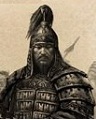
Timur (Chagatai Turkish: تیمور, "iron") (also known as Temur, Taimur, Timur Lenk, Timur-i Leng, Temur-e Lang, Tamerlane, Tamburlaine, and Aqsaq Timur which translates to Timur the Lame, as he was lame after sustaining an injury to the leg as a child) (1336–February 1405) was a great 14th century Turco-Mongol/Turco-Persian warlord, founder of the Timurid Empire (1370–1405) in Central Asia, and the Timurid dynasty, which survived in some form until 1857.
He ruled over an empire that extends in modern nations from south Eastern Turkey, Syria, Iraq, Kuwait, Iran, through central Asia encompassing part of Kazakhstan, Afghanistan, Russia, Turkmenistan, Uzbekistan, Kyrgyzstan, Pakistan, India, even approaching Kashgar in China.
His legacy is a mixed one, for while Central Asia blossomed, some say even peaked, under his reign, other places such as Baghdad, Damascus and other Arab, Persian and Turkish cities were sacked and destroyed, and many thousands of people were slaughtered. Thus, while Timur remains a hero of sorts in central Asia, he is vilified by many in Arab and Persian societies.
Early life
Timur was born in Transoxiana, near Kesh (an area now better known as Shahr-e Sabz), 'the green city,' situated some 50 miles south of Samarkand in modern Uzbekistan.
Timur placed much of his early legitimacy on his genealogical roots to the great Mongol conqueror, Chinggis or Genghis Khan. What is known is that he was descended from the Mongol invaders who initially pushed westwards after the establishment of the Mongol empire.
His father Taraghai was head of the tribe of Barlas, a nomadic Turkic-speaking tribe of Mongol origin that traced its origin to the Mongol commander Qarachar Barlas. Taraghai was the great-grandson of Qarachar Noyon and, distinguished among his fellow-clansmen as the first convert to Islam, Teragai might have assumed the high military rank which fell to him by right of inheritance; but like his father Burkul he preferred a life of retirement and study.
Under the paternal eye the education of young Timur was such that at the age of twenty he had not only become an adept in manly outdoor exercises but had earned the reputation of being an attentive reader of the Qur'an. Like his father, Timur was a Muslim and seems to have been influenced by Janbalani Sufism. At this period, if we may credit the Memoirs (Malfu'at), he exhibited proofs of a tender and sympathetic nature (These are generally now held to be spurious). Later he had converted to be Nusairi by Sayyed Barakah, a Nusairi leader from Balkh that had a strong influence on Taimur.
Military leader
Map of the Timurid Empire in 1405 (In Grey)About 1360, however, he gained prominence as a military leader. Timur took part in campaigns in Transoxania with the khan of Chagatai, a descendant of Genghis Khan. His career for the next ten or eleven years may be thus briefly summarized from the Memoirs. Allying himself both in cause and by family connection with Kurgan, the dethroner and destroyer of Volga Bulgaria, he was to invade Khorasan at the head of a thousand horsemen. This was the second military expedition which he led, and its success led to further operations, among them the subjection of Khwarizm and Urganj.
After the murder of Kurgan the disputes which arose among the many claimants to sovereign power were halted by the invasion of Tughluk Timur of Kashgar, another descendant of Genghis Khan. Timur was dispatched on a mission to the invader's camp, the result of which was his own appointment to the head of his own tribe, the Barlas, in place of its former leader Hajji Beg.
Timur's father had retired to a Muslim monastery, telling his son that "the world is a beautiful vase filled with scorpions." However, Timur was a man of action who did not follow the same path.
The exigencies of Timur's quasi-sovereign position compelled him to have recourse to his formidable patron, whose reappearance on the banks of the Syr Darya created a consternation not easily allayed. The Barlas were taken from Timur and entrusted to a son of Tughluk, along with the rest of Mawarannahr; but he was defeated in battle by the bold warrior he had replaced at the head of a numerically far inferior force.
Rise to power
UzbekistanTughluk's death facilitated the work of reconquest, and a few years of perseverance and energy sufficed for its accomplishment, as well as for the addition of a vast extent of territory. During this period Timur and his brother-in-law Husayn, at first fellow fugitives and wanderers in joint adventures full of interest and romance, became rivals and antagonists. At the close of 1369 Husayn was assassinated and Timur, having been formally proclaimed sovereign at Balkh, mounted the throne at Samarkand, the capital of his dominions.
It is notable that Timur never claimed for himself the title of khan, styling himself amir and acting in the name of the Chagatai ruler of Transoxania. Timur was a military genius but lacking in political sense. He tended not to leave a government apparatus behind in lands he conquered, and was often faced with the need to conquer such lands again after inevitable rebellions.
Period of expansion
The next 35 years, until his death, Timur spent in various wars and expeditions. Timur not only consolidated his rule at home by the subjugation of his foes, but sought extension of territory by encroachments upon the lands of foreign potentates. His conquests to the west and north-west led him among the Mongols of the Caspian Sea and to the banks of the Ural and the Volga. Conquests in the south and south-West encompassed almost every province in Persia, including Baghdad, Karbala and Kurdistan.
One of the most formidable of his opponents was Tokhtamysh who, after having been a refugee at the court of Timur, became ruler both of the eastern Kipchak and the Golden Horde and quarrelled with Timur over the possession of Khwarizm. Timur supported Tokhtamysh against Russians and Tokhtamysh, with armed support by Timur, invaded Russia and in 1382 captured Moscow. After the death of Abu Sa'id (1335), ruler of Ilkhanid Dynasty, there was a power vacuum in Persia. In 1383 Timur started military conquest of Persia. Timur captured Herat, Khorasan and all eastern Persia to 1385.
In the meantime, Tokhtamysh, now khan of the Golden Horde, turned against Timur and invaded Azerbaijan in 1385. It was not until 1395, in the battle of Kur River, that the power of Tokhtamysh was finally broken, after a titanic struggle between the two monarchs. In this war, Timur led an army of over 100,000 men north for about 500 miles into the uninhabited steppe, then west about 1000 miles, advancing in a front more than 10 miles wide. Tokhtamysh's army finally was cornered against the Volga River near Orenburg and destroyed. During this march, Timur's army got far enough north to be in a region of very long summer days, causing complaints by his Muslim soldiers about keeping a long schedule of prayers in such northern regions. Timur led a second campaign against Tokhtamysh via an easier route through the Caucasus, and Timur destroyed Sarai and Astrakhan, and wrecked the Golden Horde's economy based on Silk Road trade.
India
In 1398 Timur, informed about civil war in India (started in 1394), began war against the Muslim Ruler in Delhi. He crossed the Indus River on September 24. Capture of towns and villages were accompanied, very often, with their destruction and the massacre of the inhabitants.On his way to Dehli he met fierce resistance put up by the Governor of Meerut, Qilladar (Qilla means Fort ; Qill-dar means Fort Commander) Ilyaas Awan Alvi who engaged him in an intense battle which lasted nearly two months inflicting heavy losses on both sides,but after the honourable death of Ilaas Awan while fighting courageously,Taimur very much impressed by Ilyaas Awan's bravery was able to easily reach near Dehli to meet with the armies of Emperor himself Sultan Nasir-u-Din Mehmud who was already weak due to fight for power in the Royal Family. Army of Emperor Sultan Nasir-u-Din Mehmud of Tughlaq Dynasty were easy defeated and destroyed on December 17. Timur entered in Delhi and the city was sacked, destroyed and left in a mass of ruins. Before the battle for Delhi, Timur executed more than 50,000 captives, and after the sack of Delhi almost all inhabitants that were not killed were captured and deported. It is said that the devastation of Delhi was not Timur's intent, but that his horde could simply not be controlled after entering the city gates.[citation needed] However, some historians have stated that he told his armies they could have free reign over Delhi.
Timur left Delhi probably in January 1399. In April 1399 Timur was back in his own capital beyond the Oxus (Amu Darya). An immense quantity of spoil was conveyed away from India. According to Ruy Gonzáles de Clavijo, ninety captured elephants were employed merely to carry stones from certain quarries to enable the conqueror to erect a mosque at Samarkand, probably the enormous Bibi-Khanym Mosque.
Last campaigns and death
Before the end of 1399 Timur started a war with Bayezid, sultan of Ottoman Empire, and Mamluk, sultan of Egypt. Bayezid began annexing the territory of Turkmen and Muslim rulers in Anatolia. As Timur claimed suzeiranity over the Turkmen rulers, they took refuge behind him. Timur invaded Syria, sacked Aleppo, and captured Damascus after defeating Mamluk's army. The city's inhabitants were massacred, except for the artisans who were deported to Samarkand. This led to Tamarlane's being publicly declared an enemy of Islam.
He invaded Baghdad in June 1401. After the capture of the city, 20,000 of its citizens were massacred. Timur ordered that every soldier should return with at least two severed human heads to show (many warriors were so scared they killed prisoners captured earlier in the campaign just to ensure they had heads to present to Timur). In 1402, Timur invaded Anatolia and defeated Bayezid in the Battle of Ankara. Bayezid was captured in battle and subsequently died in captivity. Timur also captured Smyrna from the Knights of Rhodes. This was his last campaign.
By 1368, the Ming had driven the Mongols out of China. The first Ming Emperor demanded, and got, many Central Asian states to pay homage to China as the political heirs to the former House of Kublai. Timur more than once sent to the Ming Government gifts which could have passed as tribute, at first not daring to defy the economic and military might of the Middle Kingdom. There is some evidence that he was in fact a secret Ming vassal.
Timur wished to restore the Mongol Empire, and eventually planned to conquer China. In December 1404, Timur started military expeditions against the Ming Dynasty of China, but the old warrior was attacked by fever and plague when encamped on the farther side of the Sihon (Syr-Daria) and died at Atrar (Otrar) in mid-February 1405. His scouts explored Mongolia before his death, and the writing they carved on trees in Mongolia's mountains could still be seen even in the twentieth century.
Of Timur's four sons, two (Jahangir and Umar Shaykh) predeceased him. His third son, Miran Shah, died soon after Timur, leaving the youngest son, Shah Rukh. Although his designated successor was his grandson Pir Muhammad b. Jahangir, Timur was ultimately succeeded in power by his son Shah Rukh. His descendant Babur founded the Mughal Empire and ruled over most of North India. Babur's descendants, Akbar, Jahangir, Shah Jahan and Aurangzeb, expanded the Mughal Empire to most of the Indian subcontinent along with parts of Afghanistan.
Markham, in his introduction to the narrative of Clavijo's embassy, states that his body "was embalmed with musk and rose water, wrapped in linen, laid in an ebony coffin and sent to Samarkand, where it was buried." His tomb, the Gur-e Amir, still stands in Samarkand. Timur had carried his victorious arms on one side from the Irtish and the Volga to the Persian Gulf and on the other from the Hellespont to the Ganges River.
Contributions to the arts
Timur became widely known as a patron to the arts. Much of the architecture he commissioned still stands in Samarqand, now in present-day Uzbekistan.
According to legend, Omar Aqta, Timur's court calligrapher, transcribed the Qur'an using letters so small that the entire text of the book fit on a signet ring. Omar also is said to have created a Qur'an so large that a wheelbarrow was required to transport it. Folios of what is probably this larger Qur'an have been found, written in gold lettering on huge pages.
_______***********************************
source :
Click Бүртгүүлэх
 Нэвтрэх
 Түгээмэл асуултууд
 Хайх
Хайх









 Bayrallaa. Tuunii zahirch bsn ulsiin talaar medeelel haanaas olj boloh talaar heleed ogooch. Ulsiin nernees avhuulaad on sar orshij baisan gazar nutag geed...
