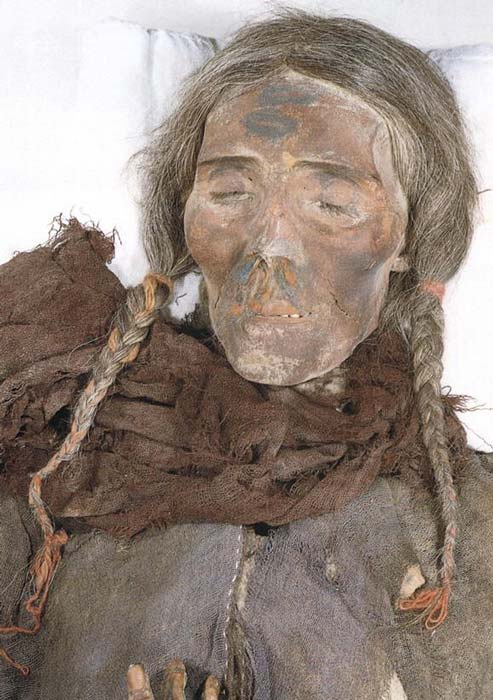
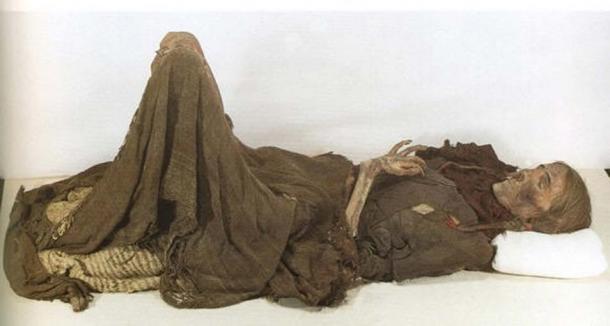
"The Andronovo have been described by archaeologists as exhibiting pronounced Europoid features.[16] A 2004 study also established that, during the Bronze/Iron Age period, the majority of the population of Kazakhstan (part of the Andronovo culture during Bronze Age), was of West Eurasian origin (with mtDNA haplogroups such as U, H, HV, T, I and W), and that prior to the thirteenth to seventh century BC, all Kazakh samples belonged to European lineages.[23] Other studies confirm, that during Bronze Age in areas to the north of present-day China, the boundary between Europoid and Mongoloid populations was on the eastern slopes of the Altai, in Western Mongolia.[24][25] Some Europoid influence extended also into Northeast Mongolia,[26] and the population of present-day Kazakhstan was Europoid during the Bronze/Iron Age period.[27] Archaeological investigations likewise suggest, that in the steppe region of Central Asia and the Altai Mountains, the first food production began towards the end of the 3rd millennium BC and that the peoples who first entered this region were Europoids of the Afanasevo culture who came from the Aral Sea area (Kelteminar culture).[28]
In 2009, a genetic study of ancient Siberian cultures, the Andronovo culture, the Karasuk culture, the Tagar culture and the Tashtyk culture, was published in Human Genetics.[16] Ten individuals of the Andronovo horizon in southern Siberia from 1400 BC to 1000 BC were surveyed.[16] Extractions of mtDNA from nine individuals were determined to represent two samples of haplogroup U4, one sample of Z1, one sample T1, one sample of U2e, one sample of T4, one sample of H, one sample of K2b and one sample of U5a1.[16] Extractions of Y-DNA from one individual was determined to belong to Y-DNA haplogroup C (but not C3), while the other two extractions were determined to belong to haplogroup R1a1a, which is thought to mark the eastward migration of the early Indo-Europeans.[16] Of the individuals surveyed only two (or 22%) were determined to be Mongoloid while seven (or 78%) were determined to be Europoid, with the majority being light-eyed and light-haired.[16]
In June 2015, another genetic study[29] surveyed one additional male and three female individuals of Andronovo culture. Extraction of Y-DNA from this individual was determined to belong to R1a1a1b2a2.[30] Extractions of mtDNA were determined to represent two samples of U4 and two samples of U2e.
Interestingly, in western Truvinian sample, the frequency of haplogroup R1a1a was considerably
lower than in the central sample. Based on the closeness of the Altai, which is populated by the representatives of a more Caucasoid SouthSiberian racial
type, it would be reasonable to expect the west–east decrease of the R1a1a frequency on the territory of Tuva. However, this was not observed, and the change of the haplogroup frequency was rather the opposite, as the eastern samples demonstrated maximum frequency of this haplogroup. At the first glance, the result obtained is paradoxical. Specifically, in terms of anthropology, the most Caucasoid population of the western parts of Tuva displays the minimum of haplogroup R1a1a, while in the most Mongoloid population of Todja, the maximum of this haplogroup is observed
http://medgenetics.ru/UserFile/File/...244-Y-Tuva.pdf Бүртгүүлэх
 Нэвтрэх
 Түгээмэл асуултууд
 Хайх
Хайх